Silver maples made the older half of this city beautiful and its sewer lines permeable. Root removal cuts the mass out of your pipe, proves it on camera, and gives you an honest plan for the regrowth that clay joints always invite.
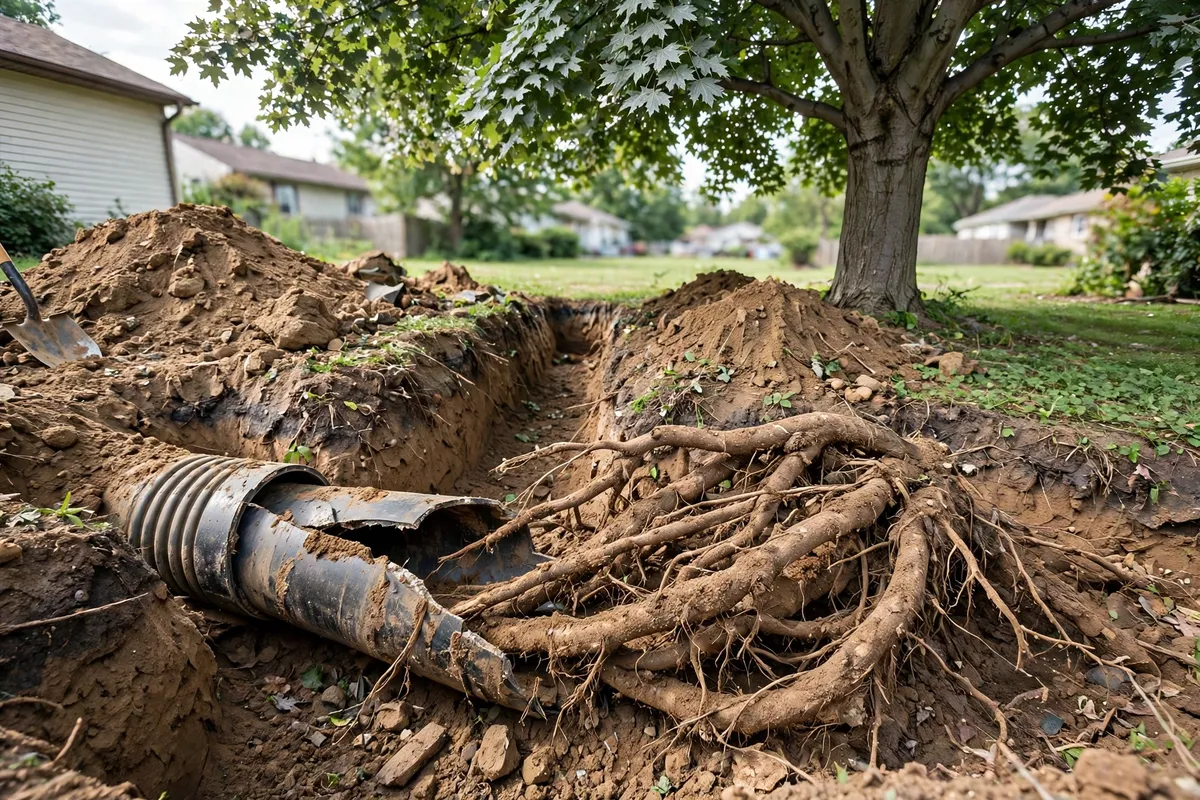
Roots enter sewer lines through the joints of clay tile, drawn by the water and nutrients inside. They arrive as hairs, thicken into mats, and finish as plugs that catch paper and grease until the line stops. Greenwood's older streets are the perfect theatre for it: clay laterals laid joint by joint, and silver maples — fast-growing, water-hungry, and planted by the thousand in the post-war decades — now mature, enormous, and rooted directly over the sewers they shade. If your home is pre-1980 in this city, the prior question is not whether roots have found your line, but how far they have got.
Removal is mechanical: a root-cutting jetter nozzle or a cutter head takes the mass back to the pipe wall, and the camera proves the result. What removal is not is a cure for the doorway — the joint that admitted the roots remains, and fine hairs will find it again on a one-to-three-year cycle. The honest service therefore ends with a plan, not just a clearing: the regrowth interval for your line, the maintenance rhythm that keeps it routine, and — where the clay is deteriorating — the relining conversation that closes the door for good.
Signs
Causes
How It Works
The intrusion is filmed and measured: which joints, how much mass, whether the clay around them is still sound.
A root-saw jetter nozzle or mechanical cutter removes the growth to the wall, working joint by joint along the run.
Cuttings are flushed to the main and the line is filmed again — you see the restored bore and the condition of every joint.
A written interval for your line and, where joints are failing, the relining or repair options that end the cycle instead of renting it.
Local Knowledge
There is a particular Greenwood education in watching your own sewer footage: joint after clay joint, each with its fringe of roots, under a street where the maples were planted the same year the houses were built. The trees and the pipes are the same age, and both are now fully grown. Root work here is therefore a mature negotiation, not a war anyone wins outright — the goal is a line kept ahead of the growth, on an interval matched to your trees, with relining reserved for the streets where the clay itself is giving up. The specialists behind this service speak that language fluently, because they re-cut the same beautiful streets every spring.
From the clay-tile streets of Old Town Greenwood and Worthsville to the newer lawns of Stones Crossing and Kensington Grove, the same service is tuned to the ground it works on. See the areas we serve for your neighbourhood's patterns, or return to Greenwood drain and sewer hub for the full picture.
Answers
Yes — through the same joints, on a cycle of roughly one to three years. Anyone who promises otherwise is selling. The choices are a maintenance rhythm, chemical root control between cuttings, or relining, which seals the joints and ends the cycle.
Almost never. The line can be maintained or relined around a healthy tree. Removal is discussed only when a tree is already failing or its roots have destroyed the pipe's structure — and that is a camera-led conversation, not a default.
Fine roots enter joints harmlessly at first, but as the mass thickens it can lever joints apart and crack aging clay. Early removal is pipe preservation, not just clog control.
A herbicide foam applied inside the line that kills root tissue in the pipe without harming the tree, used between mechanical cuttings to stretch the interval. Ask the specialist whether your line is a candidate.
Keep Reading
The full-diameter clean: roots cut, grease stripped, hard-water scale scoured — after the camera approves the pipe.
About hydro jetting →The main line restored to full bore: roots, grease and scale removed and the result filmed.
About sewer line cleaning →A jointless new pipe cured inside the old one — roots locked out, yard untouched.
About trenchless pipe relining →One call connects you with a local drain and sewer specialist serving Greenwood — camera-first diagnosis, methods matched to your pipe, options explained before anything is done.
Call (317) 555-0164