For Greenwood's kitchens: traps serviced, grease lines jetted to the wall, and discharge kept clean — on a schedule matched to your volume, documented for the health department and your own records.
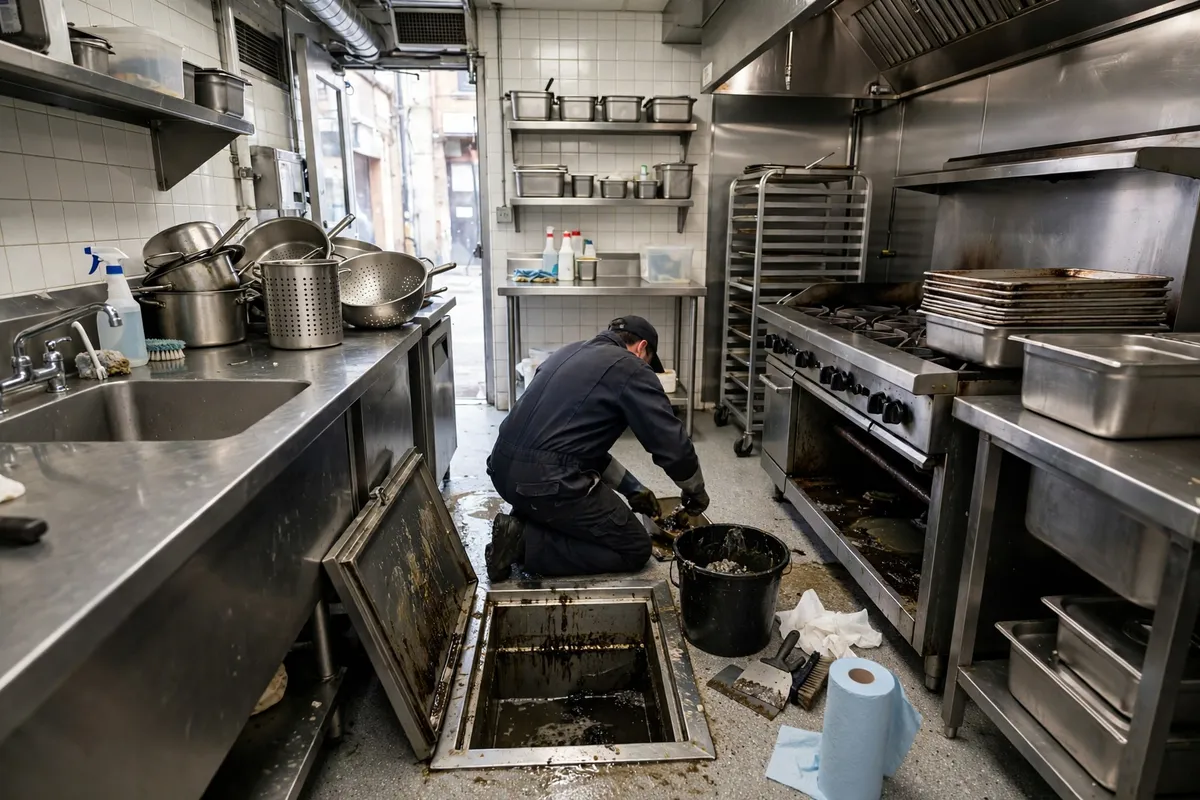
A grease trap only works while it is emptier than the rule that governs it: once the accumulated fats, oils and grease pass roughly a quarter of the trap's depth, it starts passing grease straight into your drain lines, where it cools, sets and begins the slow construction of a blockage with your name on it. Grease trap cleaning is the disciplined emptying and scraping of the trap — and, just as importantly in Greenwood's restaurant corridors, the jetting of the lines beyond it, where years of escaped grease have already set like candle wax.
The businesses along US-31, around the Greenwood Park Mall and up the County Line corridor run some of the busiest kitchens in Johnson County, and their traps fill at commercial speed. The specialists behind this service work on schedules set by your actual volume — measured at each visit, not guessed at contract signing — and leave documentation of capacity, condition and next due date. A trap serviced on rhythm is invisible. A trap serviced on hope becomes a backup during a Friday dinner rush, which is the only time it ever happens.
Signs
Causes
How It Works
The trap is pumped completely — not skimmed — and the walls and baffles scraped down, so the true capacity is restored and the condition can be seen.
Baffles, seals and the trap body itself checked; deterioration is flagged while it is still a part, not a replacement.
The discharge line is jetted to remove the set grease downstream — the step that separates a trap service from a pipe rescue later.
Fill rate measured across visits sets your interval — monthly, quarterly, whatever your kitchen actually produces — with records left for your files.
Local Knowledge
Greenwood's food map concentrates grease exactly where the city's plumbing is busiest: the mall's food operations, the US-31 strip's decades of restaurants, the County Line corridor feeding both Greenwood and south Indianapolis. Several of those kitchens drain into lines as old as the strip itself — cast iron that grease grips enthusiastically. The local discipline that works here is pairing: trap serviced on measurement, lines jetted on condition, both documented. It is unglamorous, entirely predictable, and the reason some Greenwood kitchens have never once backed up during a rush while others seem to live on a plumber's route.
From the clay-tile streets of Old Town Greenwood and Worthsville to the newer lawns of Stones Crossing and Kensington Grove, the same service is tuned to the ground it works on. See the areas we serve for your neighbourhood's patterns, or return to Greenwood drain and sewer hub for the full picture.
Answers
When its contents reach about a quarter of its depth — for most busy Greenwood kitchens that means every one to three months. The honest answer is measured at your trap, not read off a chart, and your service records will show the rate.
Grease passes through, lines narrow, and eventually the kitchen backs up — usually at peak service. Beyond the mess, chronic discharge can draw municipal attention and fines. Prevention costs less in every currency.
Both, as needed. Pumping without line care leaves the set grease downstream untouched; the condition of the discharge line is checked and jetted on the visits where it needs it.
Yes — early morning and between-service windows are standard for commercial work here. The schedule is built around your rush, not the route's convenience.
Keep Reading
Scheduled, off-hours drain programmes for Greenwood's corridors and multi-family stock.
About commercial drain cleaning →Single fixtures and branch lines, cleared with the right tool and read for what they say about the main.
About drain cleaning →The full-diameter clean: roots cut, grease stripped, hard-water scale scoured — after the camera approves the pipe.
About hydro jetting →One call connects you with a local drain and sewer specialist serving Greenwood — camera-first diagnosis, methods matched to your pipe, options explained before anything is done.
Call (317) 555-0164