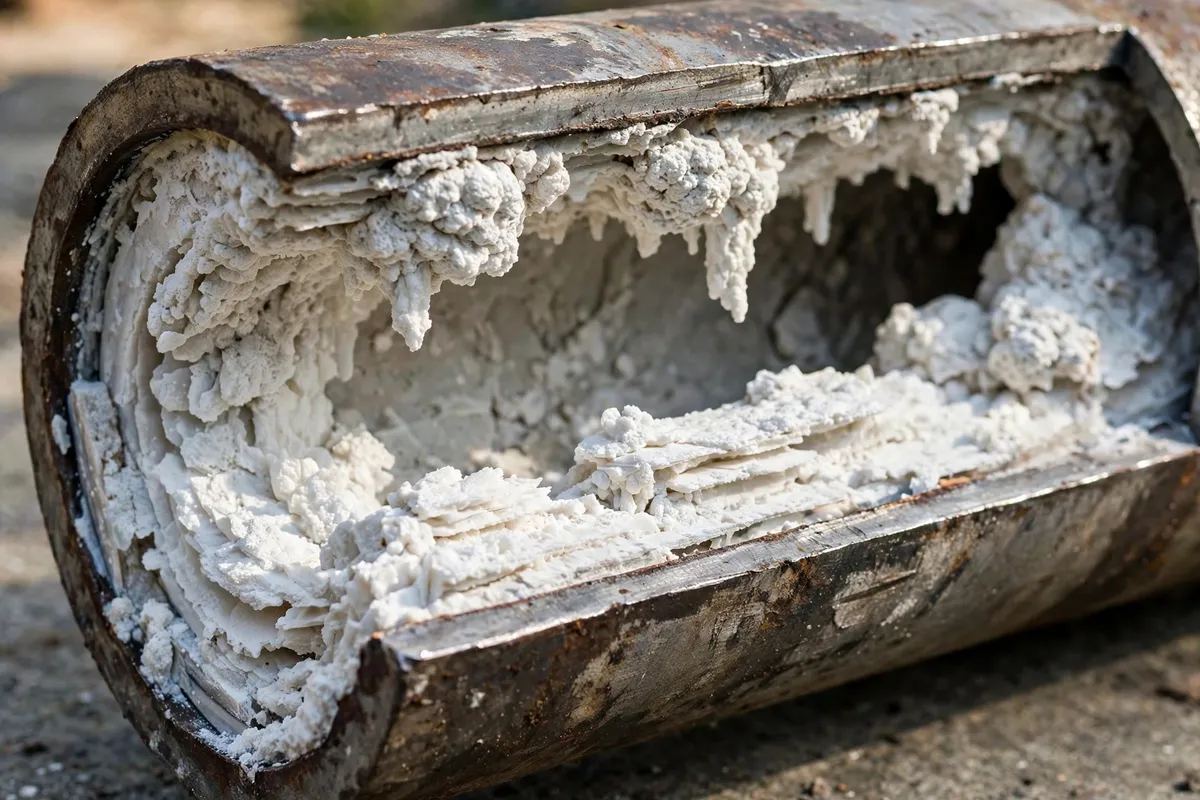
The water arrives loaded
Indianapolis-area water is drawn through limestone country, and it carries the country with it: dissolved calcium and magnesium at levels that rank among the hardest municipal supplies in the Midwest. You know it at the surface — the kettle's white fur, the shower door's spots, the water heater's shortening patience. What is less visible is that the same chemistry works inside your drains. Every gallon that leaves your house deposits a fraction of its mineral load on the pipe wall, preferentially where the wall is already rough. The drain is a cave forming in reverse: instead of water carving rock away, the water builds rock, molecule by molecule, year by year.
What the buildup becomes
Fresh scale is a thin, chalky film. Old scale is a crust — hard, crystalline, and hospitable to everything a drain owner hates. It narrows the bore: a two-inch branch line can lose a third of its diameter across a couple of decades, a main its own meaningful fraction. It roughens the surface, and roughness is a drain's original sin, because everything that should slide begins to grip. Grease sets faster on scale than on any pipe material. Root hairs entering a joint find a mineral scaffold to climb. Paper catches. The line that 'suddenly' clogs at year twenty was, on inspection, a scale story that had been writing itself since year one.
Why Greenwood feels it more
Scale builds everywhere hard water flows, but three local facts compound it here. First, the sheer hardness: the deposition rate is simply higher than in most American suburbs. Second, the housing stock's age profile: the city's great building decades mean a huge share of Greenwood lines are now in the twenty-to-sixty-year window where crust becomes constriction. Third, the materials: the cast iron of the mid-century streets offers scale a corroded, pitted wall to key into, so iron lines crust faster and hold harder than the PVC of the new south — which scales too, just more politely. No era of Greenwood construction is exempt; they merely queue at different speeds.
The symptoms are a dialect
Scale speaks in a particular accent, and learning it saves money. Drains that slow gradually, evenly, across several fixtures at once — not one dramatic clog but a house-wide loss of enthusiasm — are describing diameter lost to crust. Gurgling in lines that were silent for years. A kitchen that needs clearing annually, then twice annually, the interval shrinking as the bore does. And the subtlest sign: clearings that help less each time. A cable through a clog restores a passage; if the passage itself keeps shrinking, every clearing buys less time than the one before. That shrinking return is the scale announcing itself as the real author.
What removes it — and what does not
Chemicals first, because they are what everyone tries: descaling agents can soften a film in a fixture trap, and they are essentially irrelevant to a crusted line — the volume, contact time and safety math do not reach. Cables bore through scale's soft centre and leave the crust standing, which is why snaked scale lines relapse on shortening cycles. The method that removes scale is the one built like the thing that laid it down: water. Hydro jetting's descaling nozzles scour the crust from the wall and flush it out, restoring the bore the architect specified. On cast iron, specialists sometimes pair it with mechanical descaling tools for the heaviest crust. Either way, the principle is the same — the crust comes out, or nothing has been fixed.
Living with hard water, on a schedule
Greenwood homeowners cannot soften the city's supply at the street, and a home softener — worth having for many reasons — protects supply lines and appliances, not the drains beyond the fixtures where the water remixes and deposits anyway. The drain answer is a rhythm: a camera look every few years to watch the crust's honest rate in your particular lines, jetting on the interval that rate sets, and an end to the cycle of annual snakings that buy less each time. Scale is geology, and geology does not negotiate — but it does keep a schedule, and a homeowner who reads it once can plan around it for the life of the house.
Dealing with the problem right now? The Greenwood drain services pages cover each fix in the same plain language, and the homepage explains how this referral service works.
Talk to a Greenwood drain specialist
One call connects you with a local drain and sewer specialist serving Greenwood — camera-first diagnosis, methods matched to your pipe, options explained before anything is done.
Call (317) 930-2241